

Why It’s More Than Just Poor Handwriting and Why It’s Related to Dyslexia
Sean, 9, can describe a groundhog’s complex burrows in vivid detail. But ask him to write 2 sentences about it, and he freezes. He stalls. He erases, starts over, and stalls again. An hour later, he quits, with a hole in the middle of the paper.
This scenario plays out repeatedly like Groundhog Day in countless households every evening. Parents and caretakers press children like Sean to try harder. The evening inevitably ends with tears and angry words.
Families are at a loss as to what to do until they stumble on the word “dysgraphia.” Can it be dysgraphia?

What Is Dysgraphia, Exactly?
Dysgraphia is often identified by a persistent discrepancy between a person’s actual v. expected writing ability based on their age, instruction, and general intelligence (Chung et al., 2020). Dysgraphia is a language-based specific learning disorder affecting written expression. With dysgraphia, the brain has difficulty translating thoughts into writing with the speed and accuracy expected at that age.
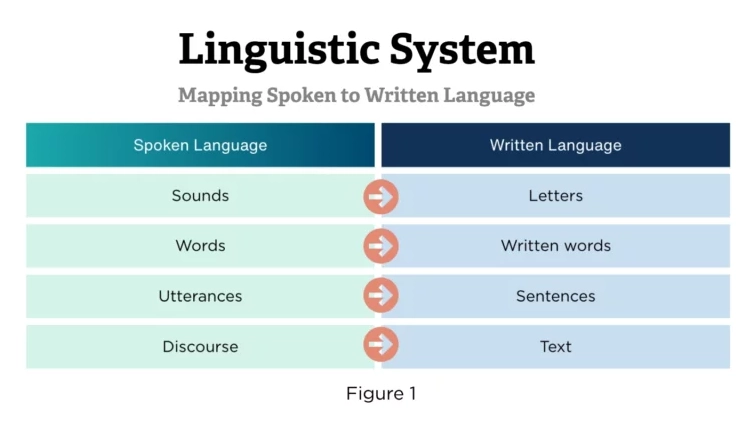
But for a clearer picture of the difficulty, let me illustrate with 2 diagrams. Figure 1 shows the building blocks of the linguistic system. Spoken language is made up of sounds, words, utterances and discourse (stretches of talk). Correspondingly, written language comprises letters, written words, sentences and texts. While spoken language is acquired naturally, writing requires formal learning of the “code.” That is, the mapping of sounds to letters, utterances to sentences, etc.
Therefore, any problem with any part of these building blocks or mapping can create challenges with written language.
In addition to the linguistic system, written expression demands efficient operation and coordination of other brain systems, including the sensory-motor, cognitive, psycho-social and executive function (Berninger & Richards, 2002). See Figure 2. (These brain systems also affect other learning disabilities such as dyscalculia.)
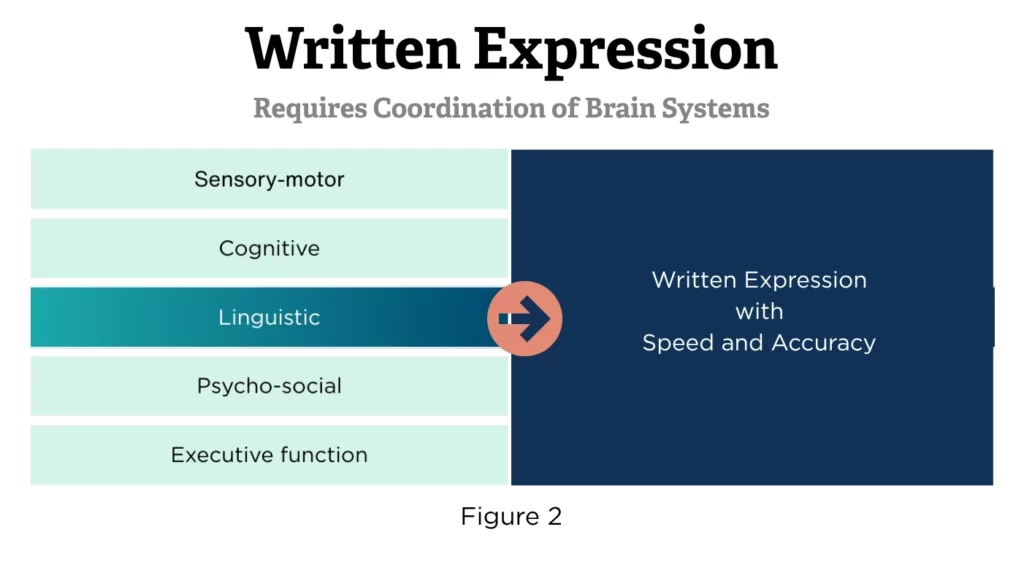
Without effective treatment targeting the source of the breakdown in these systems, the writing difficulty persists, distinguishing dysgraphia from just a developmental delay due to external factors.
As with the other learning disabilities, dyscalculia (math) and dyslexia (reading), dysgraphia presently lacks a widely accepted operational definition. An operational definition specifies exactly how the concept will be measured. (In a previous Psychology Today article, I operationalized “dyslexia” as inefficiencies in the linguistic system in the brain, much of which also apply to dysgraphia.)
Given the lack of consensus in the field on the definition of dysgraphia, estimates of its prevalence varies. But it is safe to say that it occurs in around 20% of the population–the same as for dyslexia (Chung et al., 2020).
Signs of Dysgraphia by Age
As writing demands increase with age, warning signs tend to shift from concrete, physical struggles in early childhood to more abstract, organizational challenges in adolescence.
Early Childhood — Preschool and Kindergarten
- Difficulty copying basic shapes or letters
- Difficulty retaining letters even with repeated exposure
- Inconsistent spacing and sizing in written letters/words

Elementary and Middle School
- Spelling errors in common, simple words
- Written work that is far shorter or simpler than expected
- Visible fatigue or frustration during writing tasks
Beyond the Classroom — Dysgraphia in Everyday Life
- Avoiding forms and written applications
- Trouble organizing thoughts on paper
- Difficulty taking notes at typical speed
The Diverse Ways Dysgraphia Can Manifest
Dysgraphia does not look the same from person to person. This is because it can result from inefficiencies in different parts of the linguistic system or the other brain systems. One child may struggle with spelling and getting words out on paper while another grapples with the physical act of forming letters on the page. A single child may show multiple patterns of difficulty or even multiple disorders, often leading to missed or misleading diagnosis.
Some of the labels used commonly are motor dysgraphia (physical handwriting) and spatial dysgraphia (visual organization). These labels are merely a few ways to segment the condition, which occurs along a continuum across functional systems of the brain. Rather than try to fit a child to one of these labels, it is more helpful to locate the specific sources of difficulties in the brain systems affected.
Why Handwriting is Affected Sometimes
Many people think of dysgraphia as a handwriting problem, but this symptom may or may not be present. When it does, the reason may be found in motor skills or something else. For example, a child who has difficulty retaining words is compelled to copy them down letter-by-letter. Attending to each letter of the word takes away mental resources usually allocated to monitoring spacing, sizing, and visual alignment. The result is poor handwriting.
The Processing Problem with Written Language
Writing is one of the most demanding tasks that school asks of a child. It is a global task requiring the orchestration of many building blocks of language and multiple brain systems simultaneously (see Figures 1 and 2). Writing is considerably more demanding than oral expression. While the child may be able to describe groundhog hibernation verbally, they may not be able to write it down. The problem lies in the machinery required to map spoken language to the written code and coordinating several brain systems to externalize their thoughts onto the page.
Dysgraphia and Dyslexia
Around 30-47% of children with writing problems also have reading problems, and the reverse overlap runs high as well. Reading difficulty, or dyslexia, involves language reception whereas writing difficulty, or dysgraphia, entails language production. There is a lot of overlap in the language processes activated for both, but production–the act of creation–is more demanding. This is why some students can read passably well but struggle with written composition.
What do Dysgraphia Evaluations Offer?
Traditional evaluations by school or private specialists usually assess these:
- Handwriting speed and legibility
- Spelling
- Written composition
- Fine motor skills
- Screening for related conditions such as dyslexia and ADHD
However, before taking this route, consider these questions:
- At the end of the evaluation, will you know the source(s) of the writing difficulty?
- Does it tell you how to mitigate if not resolve this difficulty?
- Better still, can the evaluator, informed by their assessment results, design and conduct the appropriate intervention to follow?
If the answer is No, then you’re only getting a label.
Why Accommodations Alone Are Not Enough
Extended time, speech-to-text software and shorter assignments make school life easier but do not address the underlying processing problem that made writing hard in the first place. It is important to distinguish between 2 major approaches: compensating for the difficulty v. correcting the root problem
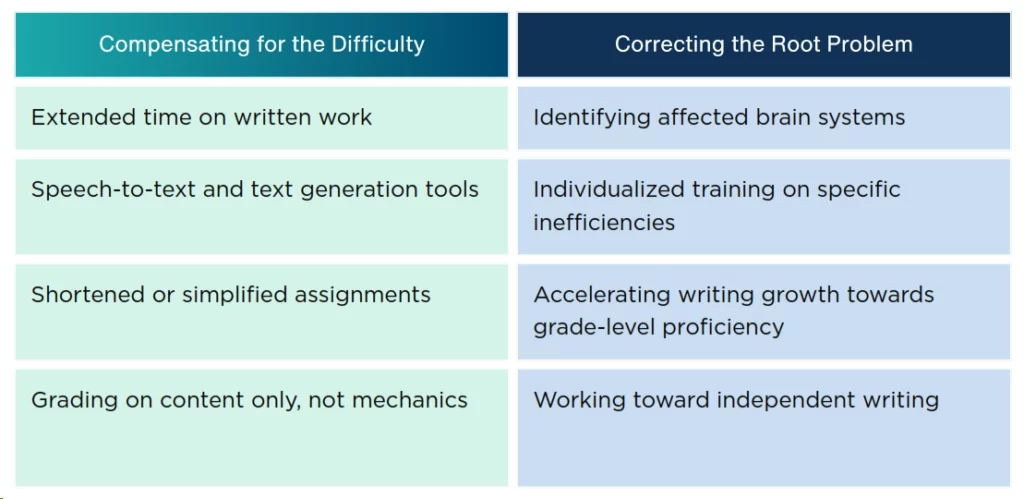
Research on dysgraphia interventions over the past two decades points towards the same direction: no single approach in isolation, whether motor training alone or technology alone, moves the needle as much as an individualized combination aimed at the specific root problem (Han & Wang, 2025).
Accommodations still matter, especially for older students who have a lot of ground to cover to catch up. But treating accommodation as the finish line, instead of a bridge, is where many well-meaning support plans stall out. The question worth asking about any program is this: Is it designed to resolve the difficulty, or does it simply make room around it?

New Treatment for Dysgraphia
New treatments for dysgraphia will likely involve finding the root problem in the brain, as Dysolve is presently doing for dyslexia. This evidence-backed method for dyslexia focuses on improving the efficiency of foundational language processes before instruction on reading skills begins. Dysgraphia can also have this foundational evaluation as the starting point. Then assessment following Dysolve’s foundational training can determine remaining gaps that need to be filled to reach writing proficiency.
Note: A shorter version of this article was published in Psychology Today on August 9, 2026.
References
- Chung, P. J., Patel, D. R., & Nizami, I. (2020). Disorder of written expression and dysgraphia: Definition, diagnosis, and management. Translational Pediatrics, 9(Suppl 1), S46-S54. http://dx.doi.org/10.21037/tp.2019.11.01
- Han, W., & Wang,T. (2025). From motor skills to digital solutions: Developmental dysgraphia interventions over two decades. Children, 12, 542. https:// doi.org/10.3390/children12050542
- Berninger, V. W. (2009). Teaching students with dyslexia and dysgraphia: Lessons from teaching and science. Towson, MD: Brookes.
- Berninger, V. W., & Richards, T. L. (2002). Brain literacy for educators and psychologists. New York, NY: Academic.