FIRST DYSOLVE® PILOT
RANDOMIZED CONTROLLED TRIAL
The first Dysolve pilot took place in an afterschool program at a junior high school in New York state in 2014 for twenty-six 6th and 7th graders. Pre-test, participants were at Level 1 or 2 on the New York State’s English Language Arts (ELA) assessment (Level 3 = Meets Proficiency Standard; Level 1 = Well Below Proficiency).
In this randomized controlled trial (RCT), controls received the Orton-Gillingham-based Wilson Reading System® taught by an experienced school teacher with Wilson Level 1 certification. Orton Gillingham is the methodology promoted by dyslexia advocates including the International Dyslexia Association, formerly the Orton Society. It is the most widely used approach in schools.
The study design followed the recommended criteria of the Institute of Education Sciences (2013) and the National Reading Panel (2000) for efficacy research, as well as recommended guidelines for fidelity of implementation, procedural reliability, and inter-rater reliability. The study was approved by a university Institutional Review Board and the district’s school board.
RESULTS
Comparison of segmentation results
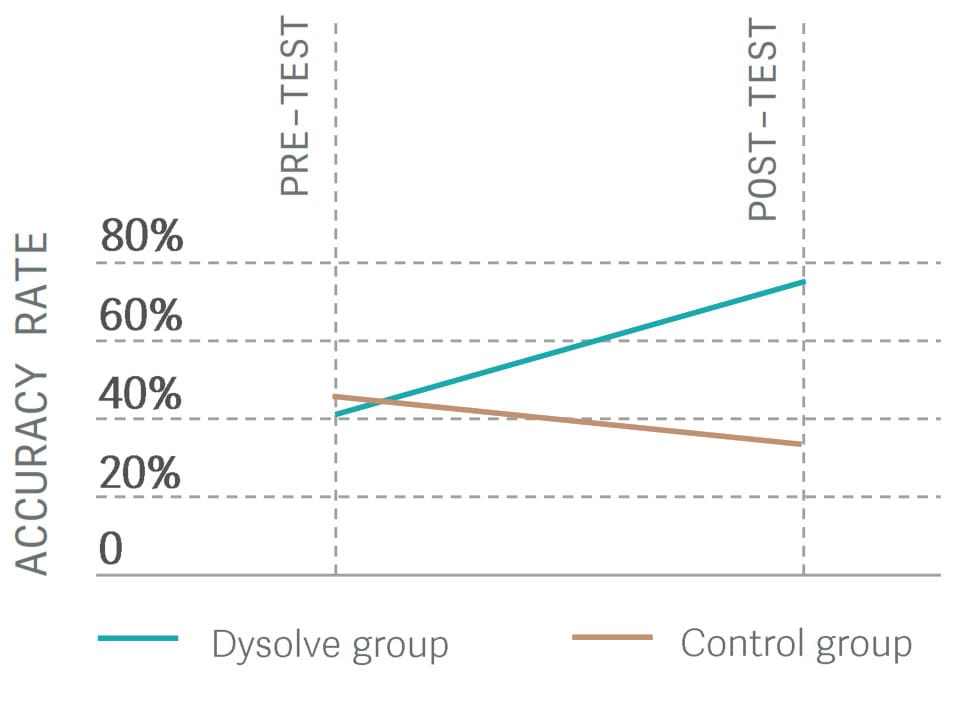
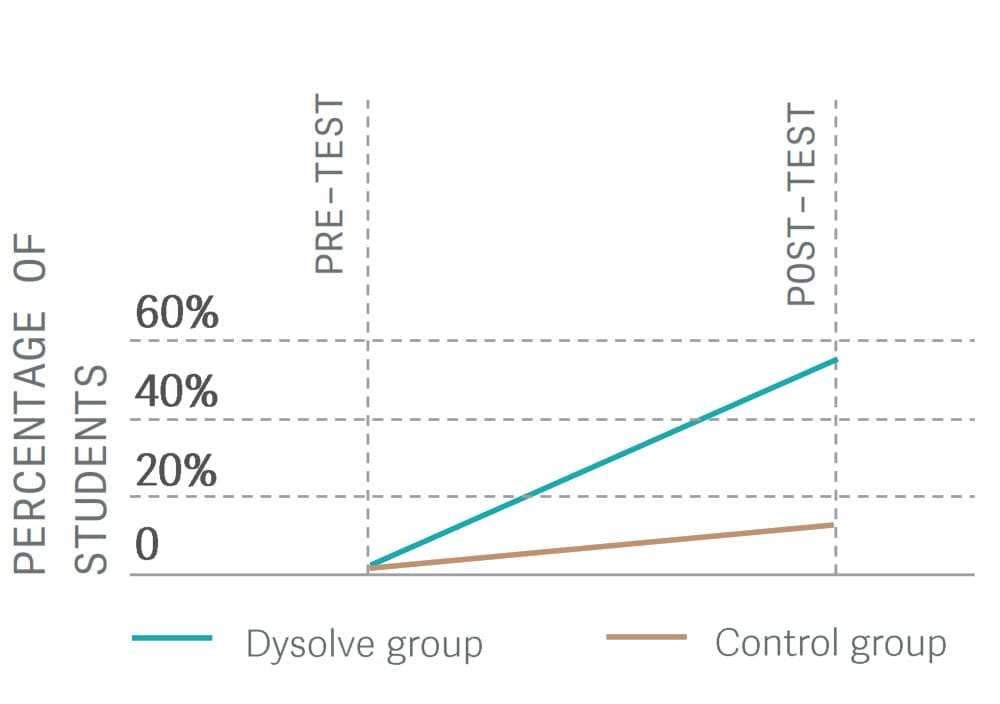
Percentage of students who scored above 50% in single -word reading at 200 wpm
STATISTICAL SIGNIFICANCE
A series of chi-squared tests revealed no significant differences between the Dysolve and Control Groups in terms of gender, minority status, participation in speech/language therapy, grade level, and two-/single-parent household.
A series of analyses of covariance (ANCOVAs) were run to examine the effect of the intervention on segmentation skill. Both ELA and segmentation pre-test scores were entered as covariates. Table 1 shows unadjusted and adjusted means for these analyses. The ANCOVA for the segmentation test revealed a significant effect of the intervention, F(1, 12) = 15.11, p = .002, η2 = .557, with students in the Dysolve Group performing better (see Table 2). This transfer effect was important, considering that training was only for 3 months.
TABLE 1. DESCRIPTIVE STATISTICS OF UNADJUSTED AND ADJUSTED MEANS OF SEGMENTATION POST-TEST BY GROUP
UNADJUSTED MEANS
| Group | Mean | Std. Deviation | N |
|---|---|---|---|
| Control | 23.2857 | 10.67262 | 7 |
| Dysolve | 45.3333 | 7.08872 | 9 |
| Total | 35.6875 | 14.14081 | 16 |
ADJUSTED MEANS
| 95% Confidence Interval | |||
|---|---|---|---|
| Mean | Std. Error | Lower Bound | Upper Bound |
| 23.667a | 3.766 | 15.461 | 31.873 |
| 45.037a | 3.226 | 38.008 | 52.065 |
a. Covariates appearing in the model are evaluated at the following values:
ELA Grade 4 score = 626.88, segmentation pre-test score = 26.2500.
TABLE 2. SEGMENTATION POST-TEST: TESTS OF BETWEEN-SUBJECTS EFFECTS
| Source | Type iii Sum of Squares | df | Mean Square |
|---|---|---|---|
| Corrected Model | 2112.652b | 3 | 704.217 |
| Intercept | .778 | 1 | .778 |
| ELA Grade 4 | 17.658 | 1 | 17.658 |
| Segmentation Pre-test |
165.954 | 1 | 165.954 |
| Group | 1116.269 | 1 | 1116.269 |
| Error | 886.785 | 12 | 73.899 |
| Total | 23377.000 | 16 | |
| Corrected Total | 2999.438 | 15 |
| f | Sig. | Partial Eta Squared | Observed Powerc |
|---|---|---|---|
| 9.529 | .002 | .704 | .977 |
| .011 | .920 | .001 | .051 |
| .239 | .634 | .020 | .074 |
| 2.246 | .160 | .158 | .281 |
| 15.105 | .002 | .557 | .945 |
b. R Squared=.704 (Adjusted R Squared=.630)
c. Computed using alpha = .05
5-YEAR FOLLOW-UP
OTHER DYSOLVE® PILOTS
DYSOLVE® BETA USERS
Similar growth trends occurred with Dysolve beta users between 2017-2020. Dysolve AI succeeded in getting struggling readers to the 50th percentile in state and standardized reading assessments in 1.5 years on average. Beta users were primarily in late elementary and middle school, scoring below the 25th percentile pre-Dysolve . Again, for those who completed their Dysolve programs, they attained Honors or grades in the 90s in high school.
Some of these early cases were described in detail in the book Dyslexia Dissolved: Successful Cases of Learning Disabilities, ADHD and Language Disorders.
Dysolve is the first corrective intervention for reading disability that relies fully on AI, without any human instruction. Other interventions are compensatory, to help students cope with the difficulty throughout school.